


 PLATFORM UPDATE:


Supramolecular hybrid of Fe pentanuclear complex/diblock copolypeptide amphiphiles with pH-responsive nano/microstructures in water

Abstract
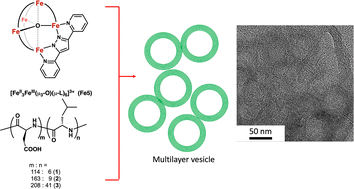
A pentanuclear iron (Fe5) complex was successfully co-assembled with an amphiphilic diblock copolypeptide in aqueous solution, forming well-organized supramolecular aggregates that exhibit distinct spectroscopic and redox properties. The hybrids adopted pH-responsive morphologies ranging from vesicle-like structures to micron-scale sheets, as confirmed by dynamic light scattering (DLS), scanning electron microscope (SEM), and transmission electron microscope (TEM) analyses. These measurements demonstrated that pH-dependent changes in aggregation state directly influence the redox behavior of the Fe5 complex. Cyclic voltammetry (CV) revealed that hybrids incorporating longer poly(L-aspartic acid) segments and shorter poly(L-leucine) segments displayed enhanced water accessibility and ion transport, resulting in pronounced pH-dependent redox shifts. Vesicle-like structures, in particular, facilitated greater interaction between the metal centers and the aqueous environment, thereby promoting redox activity. Collectively, these findings demonstrate that the self-assembled peptide matrix regulates both the oxidation state and electrochemical response of the pentanuclear iron complex. This work highlights a promising strategy for tuning supramolecular environments to modulate catalytic behavior and provides a foundation for designing bioinspired polypeptide–metal complex hybrid systems capable of improving electrocatalytic water oxidation and oxygen evolution efficiency.
- This article is part of the themed collections: Materials Advances Covers, Supramolecular peptide and protein systems and Popular Advances
 Please wait while we load your content...


