


 PLATFORM UPDATE:


Adsorption of wastewater pollutants on amorphous TiO2: an atomistic simulation study
 a
Filippo
Balzaretti,
ab
Manuela
Romero,
a
Wilke
Dononelli,
acd
Lucio
Colombi Ciacchi,
ac
Giancarlo
Franzese
ef
and
Susan
Köppen-Hannemann
*ac
a
Filippo
Balzaretti,
ab
Manuela
Romero,
a
Wilke
Dononelli,
acd
Lucio
Colombi Ciacchi,
ac
Giancarlo
Franzese
ef
and
Susan
Köppen-Hannemann
*ac
Abstract
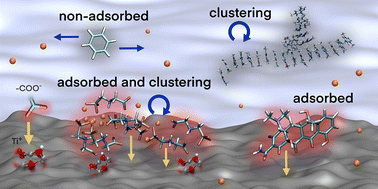
The increasing presence of polluting chemicals in man-made wastewater poses significant environmental and health risks. Advanced oxidation processes, particularly those involving photocatalytic materials like titanium dioxide (TiO2), offer a promising solution for degrading these pollutants. This study employs force field molecular dynamics simulations to investigate the interactions between pollutants, the TiO2 surface, water and ions, aiming to elucidate their role in the adsorption process. The results reveal that the protonation state of pollutants significantly influences their contact with the TiO2 surface, with negatively charged species showing a higher affinity for the surface's active sites, especially those containing carboxylate groups. The formation of hydrogen bond networks affects the stability of these contacts positively, while the tendency of some pollutants to aggregate hinders surface contacts. Furthermore, we observe cations (Na+) to alter the surface-near environment in a typical electrical double-layer manner, as well as to participate in pollutant adsorption and aggregation. These findings provide insights into the adsorption features triggering the initial pollutant degradation on amorphous TiO2, which could enhance the design of more efficient wastewater treatment technologies.
- This article is part of the themed collection: Materials Advances Covers
 Please wait while we load your content...


