


 PLATFORM UPDATE:

Al-driven cement functionality by manifold structuring & disorder

Abstract
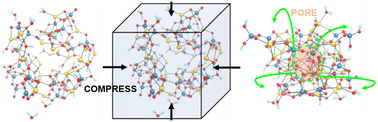
Cementitious calcium–silicate–hydrate (C–S–H) gel structures with differing aluminium (Al) content and structuring were characterised by a series of ab initio molecular dynamics (AIMD) experiments. Differing Al-binding modes and coordinations (4, 5, 6) were incorporated into dynamic simulations of various C–S–H bulk structures (layered, non-layered, anhydrous porous, hydrated porous) to resolve Al's configurational preference as well as any effects on Si/Al chain structure, including Lowenstein type ‘Al-avoidance’ (preference for non-neighbouring Al atoms) and Pore sizes. Emphasis was placed on modelling fault lines in C–(A–)S–H structures, where local order is thought to be lost. These regions tend to have high concentrations of micro stresses that potentially induce crack propagation and would thus possibly benefit from Al-toughening. Principal aspects of Loewenstein's Al avoidance are not operative in the majority of cases, with alternating Al atoms increasing chain length and branching giving rise to larger pores. O–Al–O and Al–O–Al bond angles were shown to be more flexible than their Si counterparts (O–Si–O, Si–O–Si), the former Al-units effectively acting as atomic hinge points. Al-coordination was shown to shift dynamically throughout each simulation, generally occupying tetrahedral Al-IV geometry with some preference for penta-coordinated Al-V at Q2 and Q3 sites. Loewenstein's principle of opposite coordination modes for adjacent Al are observed; specifically, Al neighbours will seldom hold the same coordination geometry. Through this approach we have demonstrated structuring of C–(A–)S–H containing stable hydrated pores, in agreement with experimental trends arising from empirical NMR and small angle neutron scattering (SANS) measurements in established works.
- This article is part of the themed collections: Materials Advances Covers, Popular Advances and Celebrating International Women’s Day 2026: Women in Materials Advances
 Please wait while we load your content...


