


 PLATFORM UPDATE:

Photo-assisted water splitting over a NiCoP/g-C3N4 heterostructure: understanding the role of visible light in electrochemical water splitting

Abstract
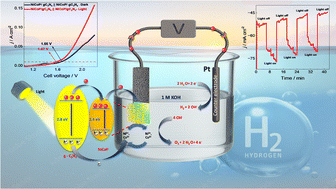
Visible-light assistance plays a pivotal role in enhancing the electrochemical reaction kinetics of photoresponsive electrocatalysts by generating additional photocarriers that participate in the interfacial HER and OER processes. Herein, we report the synthesis of a NiCo-MOF grown in situ on an optimised amount of g-C3N4 nanosheets, followed by phosphidation to yield a NiCoP/g-C3N4 heterostructure via a two-step process. The electrocatalytic performance of the NiCoP/g-C3N4 heterostructure was systematically evaluated under both visible-light irradiation and in the dark. Under visible-light illumination, the catalyst required overpotentials of 222 mV and 210 mV (iR-corrected) for HER and OER, respectively, at a current density of 100 mA cm−2 with Tafel slopes of 85.9 mV dec−1 and 68.8 mV dec−1. In contrast, under dark conditions, the overpotentials increased to 277 mV and 260 mV (iR-corrected) for the HER and OER, with Tafel slopes of 98.8 mV dec−1 and 86.5 mV dec−1, respectively. Notably, the overpotentials required are reduced by 1.25 times compared to dark conditions. Furthermore, in a two-electrode system comprising NiCoP/g-C3N4‖NiCoP/g-C3N4, a cell voltage of 1.57 V under illumination and 1.65 V in the dark was required to achieve a current density of 10 mA cm−2. The catalyst also demonstrated excellent stability, maintaining activity for 24 hours at a high current density of 400 mA cm−2 without noticeable degradation, and delivering a faradaic efficiencies of 97% for HER and 96% for OER under illumination. This study highlights how visible-light integration, via photoexcitation of g-C3N4 and synergistic coupling with NiCoP, enhances electrochemical water splitting performance, providing a practical strategy for designing highly efficient heterointerface electrocatalysts for photo-assisted water splitting.
- This article is part of the themed collections: Materials Advances Covers and Popular Advances
 Please wait while we load your content...


