MaGIC-OT: an AI-guided optical tweezers platform for autonomous single-cell isolation in microfluidic devices

Abstract

Automating the isolation of rare cells such as circulating tumour cells (CTCs) within crowded microfluidic environments remains a bottleneck in liquid biopsy workflows. Optical tweezers offer contact-free, selective manipulation but traditionally rely on expert operators. We present MaGIC-OT (machine-guided isolation of cells using optical tweezers), a platform that integrates classical path planning and deep reinforcement learning (DRL) to automate single-cell manipulation inside a microfluidic chip. We built a high-fidelity simulation to train and benchmark control policies and show that cooperative, human-in-the-loop training improves DRL performance. Trained agents outperform expert users in speed and isolation success in silico, and we demonstrate proof-of-concept isolation of a cancer cell from a spiked blood sample on-chip. MaGIC-OT provides a flexible framework for intelligent optical manipulation, aligning microfluidic device design with autonomous control strategies and offering a pathway toward high-purity, label-free single-cell workflows.
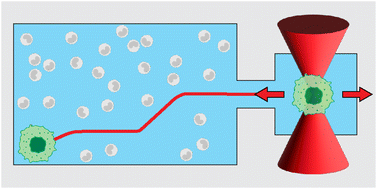
Graphical abstract: MaGIC-OT: an AI-guided optical tweezers platform for autonomous single-cell isolation in microfluidic devices

Article information

Article type
Paper
Submitted
25 Jul 2025
Accepted
03 Jan 2026
First published
12 Feb 2026
This article is Open Access
Creative Commons BY-NC license

Lab Chip, 2026, Advance Article

MaGIC-OT: an AI-guided optical tweezers platform for autonomous single-cell isolation in microfluidic devices

J. Cieslik, X. Xia and A. Salehi-Reyhani, Lab Chip, 2026, Advance Article , DOI: 10.1039/D5LC00738K

This article is licensed under a Creative Commons Attribution-NonCommercial 3.0 Unported Licence. You can use material from this article in other publications, without requesting further permission from the RSC, provided that the correct acknowledgement is given and it is not used for commercial purposes.

To request permission to reproduce material from this article in a commercial publication, please go to the Copyright Clearance Center request page.

If you are an author contributing to an RSC publication, you do not need to request permission provided correct acknowledgement is given.

If you are the author of this article, you do not need to request permission to reproduce figures and diagrams provided correct acknowledgement is given. If you want to reproduce the whole article in a third-party commercial publication (excluding your thesis/dissertation for which permission is not required) please go to the Copyright Clearance Center request page.

Read more about how to correctly acknowledge RSC content.

Social activity

Spotlight

Advertisements