A Tumor Spheroid Array Chip for High-Fidelity Evaluation of Liposomal Drug Delivery Through the EPR Effect

Abstract

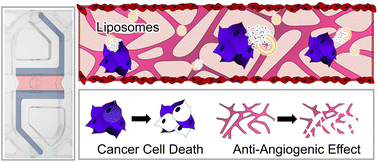
Conventional two-dimensional (2D) culture systems fail to recapitulate the structural and functional complexity of the tumor microenvironment (TME), limiting their translational relevance for preclinical drug evaluation. Here, we present a high-throughput microfluidic Tumor Spheroid Array (TSA)-Chip for investigating nanocarrier-based cancer therapies under physiologically perfusable conditions. Multicellular colorectal tumor spheroids—comprising cancer cells, endothelial cells, and fibroblasts—were embedded in a fibrin hydrogel to facilitate the formation of peritumoral vascular networks. The TSA-Chip enables continuous medium perfusion, live imaging, and quantitative assessment of vascular permeability. Using this platform, we evaluated the delivery and therapeutic efficacy of liposomal 5-fluorouracil (5-FU), leveraging the enhanced permeability and retention (EPR) effect. Compared to free 5-FU, the liposomal formulation showed improved tumor-specific accumulation and reduced vascular leakage. Furthermore, combination treatment with the anti-angiogenic agent Cyramza™ (ramucirumab) enhanced tumor suppression while preserving vascular integrity. This scalable and physiologically relevant platform provides a robust preclinical model for assessing nanoparticle transport and therapeutic outcomes in a perfusable TME, advancing precision oncology research.

Supplementary files

Article information

Article type
Paper
Submitted
18 Sep 2025
Accepted
05 Dec 2025
First published
23 Dec 2025
This article is Open Access
Creative Commons BY-NC license

Lab Chip, 2026, Accepted Manuscript

A Tumor Spheroid Array Chip for High-Fidelity Evaluation of Liposomal Drug Delivery Through the EPR Effect

Y. Lee, S. Kim, H. Koh, J. Y. Han, J. Ko and Y. Park, Lab Chip, 2026, Accepted Manuscript , DOI: 10.1039/D5LC00893J

This article is licensed under a Creative Commons Attribution-NonCommercial 3.0 Unported Licence. You can use material from this article in other publications, without requesting further permission from the RSC, provided that the correct acknowledgement is given and it is not used for commercial purposes.

To request permission to reproduce material from this article in a commercial publication, please go to the Copyright Clearance Center request page.

If you are an author contributing to an RSC publication, you do not need to request permission provided correct acknowledgement is given.

If you are the author of this article, you do not need to request permission to reproduce figures and diagrams provided correct acknowledgement is given. If you want to reproduce the whole article in a third-party commercial publication (excluding your thesis/dissertation for which permission is not required) please go to the Copyright Clearance Center request page.

Read more about how to correctly acknowledge RSC content.

Social activity

Spotlight

Advertisements