


 PLATFORM UPDATE:


Hydroxyquinoline-functionalised aza-crown macrocycles for lanthanide coordination
 ab
Bradley E.
Osborne,
ab
Enrique V.
García-España,
d
Michelle T.
Ma
*b
and
Nicholas J.
Long
*a
ab
Bradley E.
Osborne,
ab
Enrique V.
García-España,
d
Michelle T.
Ma
*b
and
Nicholas J.
Long
*a
Abstract
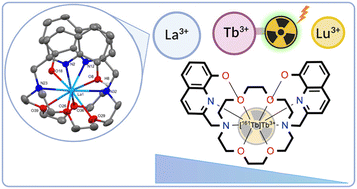
Emerging therapeutic radiolanthanides have utility for systemic molecular radiotherapy in nuclear medicine, provided that suitable chemical technology is available to incorporate them into receptor-targeted radiopharmaceuticals. In this work, N,N′-bis(8-hydroxyquinoline-2-ylmethyl)-4,13-diaza-18-crown-6 (H2KHQ) was synthesised, and its binding ability, thermodynamic stability and selectivity for Ln3+ ions (Ln3+ = La, Tb, and Lu) investigated. The design of H2KHQ involves pendant arms featuring 8-hydroxyquinoline units, known to possess metal-chelating properties and desirable activity in other therapeutic molecules. H2KHQ exhibited selectivity for the larger Ln3+ ions, confirmed by experimentally measured stability constants as well as DFT calculations. H2KHQ was able to bind the larger, non-radioactive La3+ and Tb3+ ions within 30 minutes at room temperature, forming a single, 2-fold symmetric species in solution. The structure of [La-HKHQ]2+, as determined by single crystal XRD, emphasized the need for high denticity chelators to satisfy the coordination sphere of the Ln3+, showing a 10-coordinate La3+ metal centre. H2KHQ was radiolabelled with [161Tb]TbCl3 under mild conditions in 92% radiochemical yield in promising proof-of-concept measurements.
- This article is part of the themed collection: Celebrating International Women’s Day 2026: Women in Inorganic Chemistry
 Please wait while we load your content...


