


 PLATFORM UPDATE:


One-step conversion of the Bi(NO3)3·5H2O system toward Bi5O7NO3 nanoneedles with photoactivity influenced by the butanol solvent
 *a
Ricardo
González-Campuzano,
a
Socorro
Oros-Ruiz,
b
Sandra
Cipagauta-Díaz,
c
Monserrat
Bizarro
a
and
Sandra E.
Rodil
a
*a
Ricardo
González-Campuzano,
a
Socorro
Oros-Ruiz,
b
Sandra
Cipagauta-Díaz,
c
Monserrat
Bizarro
a
and
Sandra E.
Rodil
a
Abstract
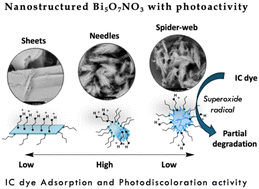
The microsheet, nanoneedle, and spider-web-like morphologies of the Bi5O7NO3 system were obtained from the direct transformation of the Bi(NO3)3·5H2O source by a simple solvothermal method, where water was partially replaced with butanol solvent in the presence of ethylenediamine. The influence of the butanol solvent concentration on the changes in the nanocrystalline structure, optical, morphological, and textural properties of the obtained bismuth-based materials was characterized by X-ray diffraction, Fourier transform IR analysis, scanning electron and transmission microscopies (SEM and HRTEM). The model conversion of the Bi(NO3)3·5H2O source is discussed in terms of dehydration and interactions with the particle's surface. The optical properties were analyzed by diffuse reflectance spectroscopy, and the UV-visible absorption capacity was correlated with the irradiance of the UV-visible lamp. The photocatalytic activity of bismuth-based materials was investigated using an indigo carmine dye solution under operational conditions that maintained high light penetration and transport coefficients, thereby keeping particulate photocatalyst loading low. The observed highest adsorption and photoactivity of the Bi5O7NO3 system were attributed to its physicochemical properties, primarily to the population of grain boundaries of the spherical nanocrystals, to the increase in the specific surface area, and to the high dispersion capacity of Bi5O7NO3 needles, where the dye discoloration reaction operates in the pseudo zero order kinetic regime.
 Please wait while we load your content...


