


 PLATFORM UPDATE:


Synergistic Co-doping and Te-defects engineering in NiTe2 single-crystals for enhanced hydrogen evolution in acidic and alkaline environments

Abstract
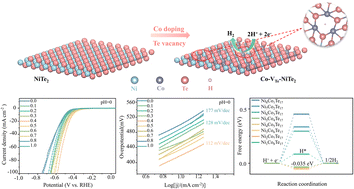
Transition metal dichalcogenides (TMDs) are promising hydrogen evolution reaction (HER) catalysts due to their layered structures and tunable electronic properties. However, NiTe2 suffers from suboptimal hydrogen adsorption energy (ΔGH*) and low active site density. Here, we propose a synergistic strategy involving Co doping and Te vacancy engineering to optimize HER performance in both acidic and alkaline electrolytes of Ni1−xCoxTe2 single crystals. Co2+ doping induces linear contraction of the a-axis lattice parameter, reducing charge transfer resistance by 80%. The synchronously formed Te vacancies significantly increase active site density, as evidenced by a 31% enhancement in double-layer capacitance. Optimized Ni0.6Co0.4Te2 achieves near-ideal ΔGH* (−0.0345 eV), delivering ultralow overpotentials of 419 mV (acidic) and 362 mV (alkaline) at 10 mA cm−2—17% and 26% lower than pristine NiTe2 respectively—with >80 h stability. This work establishes a scalable strategy for designing bifunctional electrocatalysts operable in acidic and alkaline media.
 Please wait while we load your content...


