


 PLATFORM UPDATE:


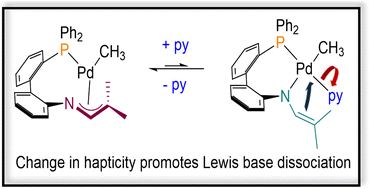
A change in ligand hapticity promotes Lewis base dissociation
Zhiqiang
Wang,  a
Paul D.
Boyle,
a
Tsun-Kong
Sham,
*a
Viktor N.
Staroverov
*a
and
Johanna M.
Blacquiere
*a
a
Paul D.
Boyle,
a
Tsun-Kong
Sham,
*a
Viktor N.
Staroverov
*a
and
Johanna M.
Blacquiere
*a
a
Paul D.
Boyle,
a
Tsun-Kong
Sham,
*a
Viktor N.
Staroverov
*a
and
Johanna M.
Blacquiere
*a
Abstract
We report a phosphine 1-azaallyl ligand L2 [2-(diphenylphosphino)-2′-(3,3-dimethyl-1-azaallyl)-1,1′-biphenyl], which enables reversible coordination of Lewis bases through changes in ligand hapticity. In the palladium methyl complex [Pd(CH3)(L2)], L2 adopts a κ1-P;η3-NCC coordination mode. Pyridine binding induces reorganization to a κ2-PN mode, while reversion to the κ1-P;η3-NCC mode facilitates pyridine dissociation. These interconversions were established by 13C{1H} and 1H–31P HMBC NMR spectroscopy, X-ray absorption spectroscopy, and density-functional theory calculations. The results highlight a ligand-controlled mechanism for reversible substrate coordination based on tunable binding modes.
 Please wait while we load your content...


