


 PLATFORM UPDATE:


Reaction of a Cp*Ir(iii) cation with mono- and di-lacunary Keggin-type heteropolytungstates and a dimer of a hexa-lacunary Dawson-type phosphopolytungstate

Abstract
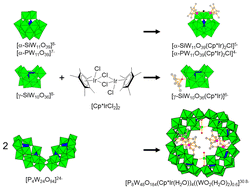
Reactions of a [Cp*Ir]2+ (Cp*: pentamethylcyclopentadienyl) complex, [Cp*IrCl2]2, with several lacunary heteropolytungstates are presented. Reactions with mono-lacunary α-Keggin type heteropolytungstates, K8[α-SiW11O39] and K7[α-PW11O39], produced Cl−-bridged di-Cp*Ir complexes such as [α-SiW11O39(Cp*Ir)2Cl]5− and [α-PW11O39(Cp*Ir)2Cl]4−, respectively, where two [Cp*Ir]2+ are bridged by Cl− and four oxygens of lacunary sites. A reaction with a di-lacunary γ-Keggin-type silicodecatungstate, K8[γ-SiW10O36], produced [γ-SiW10O36(Cp*Ir)]6−, where the [Cp*Ir]2+ moiety is attached through three bridging oxygens of the non-lacunary site. A reaction with a dimeric species of a hexa-lacunary Dawson-type phosphotungstate, [P4W24O94]24−, produced a tetra-[Cp*Ir]2+ attached cyclic tetramer, [P8W48O184(Cp*Ir(H2O))4(WO2(H2O)2)0.6]30.8−, where two inner oxygens of the cyclic tetramer and a water oxygen coordinated to Ir. [α-SiW11O39(Cp*Ir)2Cl]5− showed similar catalytic activity for H2 evolution from formic acid to that of [Cp*IrCl2]2.
 Please wait while we load your content...


