


 PLATFORM UPDATE:


Dual-function Ni-based MOF for hydrogen storage and CO2 to carbonate cyclic catalysis
 a
Helena
Montes-Andrés,
a
Jesús
Tapiador,
a
Carmen
Martos,
*a
Pablo
Salcedo-Abraira,
b
Duane
Choquesillo-Lazarte,
c
Gisela
Orcajo
a
and
Pedro
Leo
*a
a
Helena
Montes-Andrés,
a
Jesús
Tapiador,
a
Carmen
Martos,
*a
Pablo
Salcedo-Abraira,
b
Duane
Choquesillo-Lazarte,
c
Gisela
Orcajo
a
and
Pedro
Leo
*a
Abstract
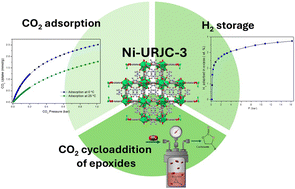
International organizations highlight the need for technological progress with minimal environmental impact. In this context, we present Ni-URJC-3, a novel nickel-based metal–organic framework (MOF) with promising performance in H2 and CO2 adsorption and as a heterogeneous catalyst for cycloaddition reactions between epoxides and CO2. The presence of azo groups (–N![[double bond, length as m-dash]](https://www.rsc.org/images/entities/char_e001.gif) N–) in the organic linker enhances both adsorption and catalytic activity, acting as Lewis bases and outperforming other Ni-MOFs, even those with higher surface areas. Ni-URJC-3 exhibits an excellent H2 gravimetric capacity of 3.7 wt% and a total volumetric uptake of 59.5 g L−1, approaching the U.S. DOE target for hydrogen storage. This is attributed to both chemical factors, such as the electronic effects of azo groups, and physical ones, including the confinement effect within its microporous structure that enhances H2 framework interactions. Regarding CO2, the material shows a high adsorption enthalpy of 35.8 kJ mol−1 and performs efficiently as a catalyst for the cycloaddition of CO2 with various epoxides. These results demonstrate the potential of Ni-URJC-3 as a multifunctional MOF for environmental applications, particularly in gas storage and CO2 transformation, contributing to the design of advanced materials aligned with sustainability goals.
N–) in the organic linker enhances both adsorption and catalytic activity, acting as Lewis bases and outperforming other Ni-MOFs, even those with higher surface areas. Ni-URJC-3 exhibits an excellent H2 gravimetric capacity of 3.7 wt% and a total volumetric uptake of 59.5 g L−1, approaching the U.S. DOE target for hydrogen storage. This is attributed to both chemical factors, such as the electronic effects of azo groups, and physical ones, including the confinement effect within its microporous structure that enhances H2 framework interactions. Regarding CO2, the material shows a high adsorption enthalpy of 35.8 kJ mol−1 and performs efficiently as a catalyst for the cycloaddition of CO2 with various epoxides. These results demonstrate the potential of Ni-URJC-3 as a multifunctional MOF for environmental applications, particularly in gas storage and CO2 transformation, contributing to the design of advanced materials aligned with sustainability goals.
- This article is part of the themed collection: Celebrating International Women’s Day 2026: Women in Inorganic Chemistry
 Please wait while we load your content...


