


 PLATFORM UPDATE:


Cationic beryllium–group 13 heterobimetallic dimetallocenes with a donor–acceptor bond

Abstract
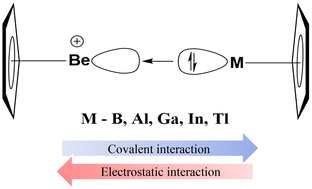
A comprehensive geometrical and bonding analysis of heterobimetallic dimetallocenes of the form [Cp–Be–M–Cp]+, where M represents group 13 elements (B, Al, Ga, In, Tl), is presented. The equilibrium geometry of dimetallocenes indicates a collinear geometry along the centre of the two Cp rings, the Be centre and the group 13 element, except for the Tl complex. Optimised geometries reveal that Be–C bond distances decrease when the group 13 element changes from B to Tl. The molecular orbital and NBO analyses show a Be–M σ-bond formed by the overlap of the 2s orbital of Be with the spn hybrid orbital of the group 13 element. The percentage of s character in the spn hybrid orbital increases as the group 13 element changes from B to Tl. However, the natural population analysis (NPA) indicates a significant charge polarisation with a low value of the Wiberg bond index. Energy decomposition analysis with natural orbitals for chemical valence (EDA-NOCV) reveals that the Be–M σ bond can be represented by a donor–acceptor interaction (Cp–Be+ ← M–Cp). Apart from the σ bonding interaction, there exists a slight π bonding interaction arising from hyperconjugative donation from the [BeCp]+ bonding molecular orbital to the [BCp] antibonding molecular orbital. Even though the strength of the Be–M bond decreases, the percentage of covalent interaction increases when the group 13 element changes from B to Tl.
- This article is part of the themed collections: Articles behind our 2026 journal covers and Celebrating International Women’s Day 2026: Women in Inorganic Chemistry
 Please wait while we load your content...


