


 PLATFORM UPDATE:


Can silaborane serve as an effective bridging unit for Lewis pairs? A comparative discourse with carborane

Abstract
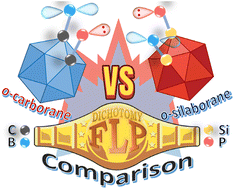
Frustrated Lewis pairs (FLPs) have emerged as versatile metal-free catalysts for small-molecule activation, and strategies to control frustration through geometric immobilization and electronic tuning remain a topic of significant interest. Carborane cages, with their unique coordination-dependent electronic effects, have recently been shown to modulate FLP frustration. In this work, we introduce o-silaborane cages, whose coordination-based electronic effects had not previously been explored for modulating FLP reactivity. The –BH2 and –PH2 substituents were strategically placed at distinct coordinating sites of the cages to systematically compare the coordination dichotomy of o-carborane and o-silaborane frameworks in influencing the frustration of Lewis pairs. CO2 activation was employed as the model reaction to assess and compare these effects. Electronic structure analysis reveals that silaborane exerts stronger electron-withdrawing and electron-donating influences than carborane, leading to pronounced differences in acidity–basicity balance, strain distribution, and the stability of CO2 complexes. Furthermore, transition-state energetics demonstrate that site-dependent positioning of Lewis acid–base centres critically governs activation barriers. In the o-carborane framework, the acid and base groups positioned at the 1,4-sites exhibit the highest reactivity, whereas in the o-silaborane system, the 4,9-substituted arrangement is identified as the most reactive. These findings establish silaborane as a promising bridging unit, opening new design pathways for tuneable FLP-based CO2 utilization and broader small-molecule activation.
- This article is part of the themed collection: Articles behind our 2026 journal covers
 Please wait while we load your content...


