


 PLATFORM UPDATE:


Expanding aromaticity tests to include lowest-lying triplet excited states and charged and heterocyclic rings
 a
and
Miquel
Solà
*a
a
and
Miquel
Solà
*a
Abstract
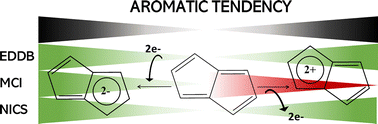
Aromaticity is a pivotal concept in chemistry arising from electron delocalization in closed-loop systems that confers extra energetic stabilization. Its direct observation is not possible, making its quantification challenging. To address this issue, several methods have been developed to quantify this non-observable property based on various physicochemical properties characteristic of these compounds. However, given the indirect nature of these measures, they do not always yield consistent or reliable aromaticity trends. Therefore, it is important to design tools that help identify which descriptors perform most effectively and put forward their weaknesses and strenghts. In a previous study (F. Feixas, E. Matito, J. Poater, M. Solà, On the performance of some aromaticity indices: a critical assessment using a test set, J. Comput. Chem., 2008, 29(10), 1543–1554.), we introduced a series of fifteen aromaticity tests that were used to analyze the advantages and drawbacks of a group of ten aromaticity descriptors. In this work, we propose to extent these initial tests of aromaticity with a series of thirteen tests related to excited state aromaticity, redox processes, and heterocyclic rings to evaluate the ability of twelve aromaticity descriptors. A comprehensive evaluation of the strengths and weaknesses of the analysed indicators of aromaticity reveals that electronic and magnetic indices perform most consistently, although the former show limitations when applied to oxidized species.
- This article is part of the themed collection: Celebrating International Women’s day 2026: Women in physical chemistry
 Please wait while we load your content...


