


 PLATFORM UPDATE:


Electrochemical study of crednerite CuMnO2 for symmetric supercapacitor applications

Abstract
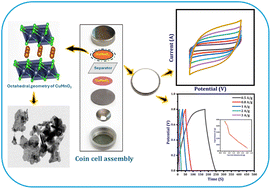
Supercapacitors are gaining prominence as a sustainable energy storage technology since they bridge the gap between batteries and conventional capacitors, offering elevated power density. In this work, we present a cost-effective and low-temperature hydrothermal method for the synthesis of CuMnO2 nanostructures. The material exhibits a monoclinic structure with C2/m space group symmetry as confirmed by X-ray diffraction (XRD) analysis. Field emission scanning electron microscopy (FE-SEM) revealed a hexagonal and rod-like structure, while energy dispersive X-ray (EDX) analysis confirmed the presence of Cu, Mn, and O in the material. X-ray photoelectron spectroscopy (XPS) validates the oxidation states of Cu and Mn. CuMnO2 demonstrated a maximum specific capacitance of 451 F g−1 at a current density of 0.3 A g−1 in a three-electrode arrangement with an energy density of 30.7 Wh kg−1. The electrode also maintains good cycling stability, while retaining 70.2% of its initial capacitance after 5000 cycles. The symmetric supercapacitor demonstrates a high specific capacitance of 175 F g−1 at a current density of 0.5 A g−1 with an energy density of 15.5 Wh kg−1 and maintains 71% cyclic stability even after 5000 cycles.
 Please wait while we load your content...


