Electrochemical Study of Crednerite CuMnO2 for Symmetric Supercapacitor Applications

Abstract

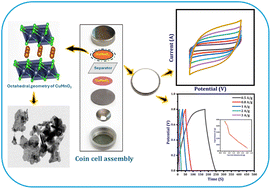
Supercapacitors are gaining prominence as a sustainable energy storage technology due to their quick charge-discharge process, high theoretical capacitance, and extended lifespan. Transition metal oxides (TMOs), particularly the copper-based delafossites CuMO2 (M: Mn, Fe, Cr, Co, Al, Ni), have sparked interest due to their layered structure and multiple oxidation states; however, optimizing their structure and electrochemical performance still presents a challenge. In this work, we represent a cost-effective and low-temperature hydrothermal method for the synthesis of CuMnO2 nanostructures. The material exhibits a monoclinic structure with C2/m space group symmetry as confirmed by X-ray Diffraction (XRD) analysis. Field emission scanning electron microscopy (FE-SEM) revealed a hexagonal and rod-like structure, while Energy Dispersive X-ray analysis confirmed the presence of Cu, Mn, and O in the material. X-ray Photoelectron Spectroscopy validates the oxidation states of Cu and Mn. The CuMnO₂ demonstrated a maximum specific capacitance of 451 F/g at a current density of 0.3 A/g in a three-electrode arrangement with an energy density of 30.7 Wh/kg. The electrode also maintains good cycling stability, while retaining 81% of its initial capacitance after 3000 cycles. The symmetric supercapacitor demonstrates a high specific capacitance of 175 F/g at a current density of 0.5 A/g, an energy density of 15.5 Wh/kg, and maintains 71% cyclic stability even after 5000 cycles.
Supplementary files

Transparent peer review

To support increased transparency, we offer authors the option to publish the peer review history alongside their article.

View this article’s peer review history

Article information

Article type
Paper
Submitted
25 Nov 2025
Accepted
08 Jan 2026
First published
09 Jan 2026

Phys. Chem. Chem. Phys., 2026, Accepted Manuscript

Electrochemical Study of Crednerite CuMnO2 for Symmetric Supercapacitor Applications

K. S. Modi, P. Patel, D. Patel, J. B. Patel, V. Solanki and M. Patel, Phys. Chem. Chem. Phys., 2026, Accepted Manuscript , DOI: 10.1039/D5CP04565G

To request permission to reproduce material from this article, please go to the Copyright Clearance Center request page.

If you are an author contributing to an RSC publication, you do not need to request permission provided correct acknowledgement is given.

If you are the author of this article, you do not need to request permission to reproduce figures and diagrams provided correct acknowledgement is given. If you want to reproduce the whole article in a third-party publication (excluding your thesis/dissertation for which permission is not required) please go to the Copyright Clearance Center request page.

Read more about how to correctly acknowledge RSC content.

Social activity

Spotlight

Advertisements