


 PLATFORM UPDATE:


First-principles study of spin-selective transport properties and quantum logic gate operation in transition-metal-capped nanowires

Abstract
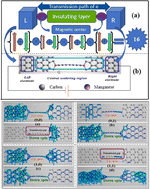
Realizing spin-operated quantum logic circuits at the nanoscopic level has been one of the major challenges in designing modern computing architectures by encoding quantum information in the spin states of electrons. The ability to manipulate these spin orientations through various physicochemical mechanisms offers a promising route towards energy-efficient, non-volatile, and high-speed alternatives to conventional electronics. In this work, we report a reconfigurable spin molecular logic device (SMLD) based on transition metal-terminated carbon nanowires bridged between two zigzag-edged graphene electrodes. Using DFT combined with the non-equilibrium Green's function formalism, we explore spin-polarized quantum transport under various biases. The constructed nano-model device exhibits strong spin polarization and voltage-dependent switching behavior, enabling the realization of multiple quantum logic gate operations—including NAND, OR, NOR, YES, and NOT—within a single architecture. I–V characteristics, transmission spectra, transmission pathways and projected device density of states (PDDOS) reveal the physical origin of logic functionality. Additionally, spin-resolved entropy analysis indicates a logic-dependent information loss of ΔS = −0.09 qubits for irreversible quantum logic gates (NAND, NOR, and OR), in contrast to zero-entropy transitions for logically reversible gates (NOT and YES). These findings trigger an expected versatile spintronics platform for low-powered, spin-based molecular logic applications, such as quantum nanochips for quantum computation.
 Please wait while we load your content...


