


 PLATFORM UPDATE:


Competitive solvation of p-nitroaniline by water, diethyl sulfoxide, n-heptane, and AOT micelles
 *a
and
Vitaly V.
Chaban
*b
*a
and
Vitaly V.
Chaban
*b
Abstract
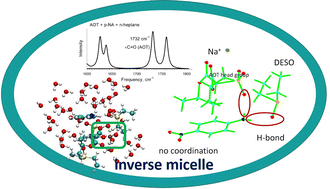
The design of inverse micelles represents a specific biomedical interest for drug delivery. We hereby investigate interactions between the docusate sodium (AOT) surfactant, n-heptane non-polar phase, diethyl sulfoxide (DESO), water, and a p-nitroaniline (NA) molecular probe. NA is hereby also used as an approximation of a drug molecule. The low-energy stationary points, representing the chosen chemical compositions, were determined via the global minimum search and confirmed at the hybrid DFT level of theory. At a small polar phase content to surfactant content ratio (Ws = 0…2), the Na-ion strongly coordinates the polar head of AOT, involving four oxygen atoms. In turn, the head group of AOT exhibits negligible binding with DESO. In all stationary configurations, DESO and water compete with the headgroup of AOT to coordinate the Na-ion. In the absence of a polar phase, NA maintains an H-bond with AOT. The increase in the polar phase fraction (Ws = 2…10) suppresses NA to AOT binding, while boosting sodium solvation by DESO and water. Numerous competitive interactions at various Ws parameters were discussed. Infrared and UV/Vis spectra were computed to bridge simulations with experiments. The reported theoretical data rationalize and supplement existing experimental insights into polar phases confined by AOT inverse micelles.
 Please wait while we load your content...


