


 PLATFORM UPDATE:


Tracking spatiotemporal quantum interference in a double-well potential by femtosecond pulse-pair excitation: a theoretical study†
 a
and
Arijit K.
De
*a
a
and
Arijit K.
De
*a
Abstract
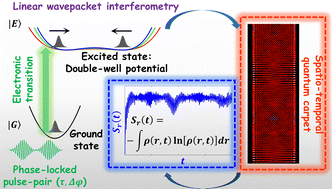
Many light-driven chemical processes (for example, excited state proton transfer, twisted intramolecular charge transfer, etc.) involve excited state potential energy surfaces having multiple local minima, driving the course of photochemistry. To unveil ultrafast coherent dynamics in such systems, we theoretically explore the excited-state linear wavepacket interferometry (WPI) upon excitation by time-delayed ultrafast pulse-pairs, modelling the excited state potential as a symmetric double-well potential. The temporal as well as spatiotemporal oscillations in excited-state population resulting from interference between wavepackets are simulated over a long period of time (of several tens of picoseconds), capturing tunnelling and reflection, both at zero temperature and at finite temperature. The influences of tuning molecular and excitation parameters, i.e., height of the barrier separating the wells and interpulse phase-locking frequency, on these oscillations are also explored. The localisation of population in either the left well or the right well as a function of interpulse delay is examined and shown to be controlled by chirping of the pulses. Further, we simulate the differential Shannon entropy as a function of time, replicating the wavepacket dynamics. Finally, we show strategies of quantum control and establish a connection between WPI in a double-well and qubits. We also extend our study to the asymmetric double-well potential to shed light on dynamics in real physical systems. Therefore, our study underscores the importance of WPI in molecular systems, having prospective applications in quantum computation and quantum information.
- This article is part of the themed collection: Structure and dynamics of chemical systems: Honouring N. Sathyamurthy’s 75th birthday
 Please wait while we load your content...


