


 PLATFORM UPDATE:


Monomer and dimer pathways of earth-abundant manganese tricarbonyl pre-catalysts for CO2 reduction studied by time-resolved IR spectroscopy

Abstract
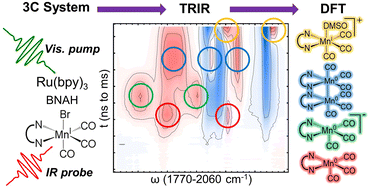
The activation mechanism of Mn-based molecular catalysts is reported in a three-component system (photosensitizer, electron donor, catalyst), investigated by time-resolved infrared spectroscopy. In total four complexes were studied that are derived from Mn(2,2′-bipyridine)(CO)3Br by varying substituents on the ligand, which impose steric constraints or modulate electronic properties. Thereby, ligand effects on catalyst activation pathways are systematically assessed. A unified feature across all systems is that the intermediate after one-electron reduction and subsequent Br− dissociation, i.e., Mn0(L)(CO)3, possesses a more positive reduction potential than the parent complex, leading to its rapid second reduction. This step outcompetes dimerization of Mn0 radicals, which instead proceeds through a symproportionation between the two-electron reduced species and the parent complex. However, when dimer formation is sterically hindered, two Mn0 species arise instead. The final process is the re-oxidation of the reduced intermediates by either hydrogen evolution or regeneration of the electron donor. Although CO2 conversion was not the focus of this work, the elucidated pathways clarify how competing re-oxidation channels can limit reduction efficiency or alter product selectivity. These mechanistic insights provide a foundation for rational strategies to control the selectivity and amplify the desired catalytic reactions.
 Please wait while we load your content...


