


 PLATFORM UPDATE:


Recent advances in non-precious metal M–N–C-based composites as bifunctional electrocatalysts for rechargeable zinc–air batteries
 *a
*a
Abstract
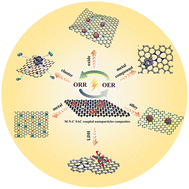
Non-precious M–N–C single-atom catalysts (M–N–C SACs) have attracted great attention due to their extremely high metal utilization efficiency (100% in an ideal situation) and high activity for the oxygen reduction reaction (ORR). However, their catalytic activity for the oxygen evolution reaction (OER) is still unsatisfactory due to the lack of suitable active sites, which limits their commercial application in rechargeable zinc–air batteries (ZABs). Coupling the M–N–C SACs with an additional OER-active component has been confirmed as an efficient strategy to achieve bifunctional oxygen electrocatalysis. In this paper, we summarised the recent progress of non-precious metal M–N–C SAC-based composites as bifunctional electrocatalysts for rechargeable ZABs. The principle for oxygen electrocatalysis is generalized, and the structure–activity relationship between M–N–C SACs and OER-active components is also highlighted and discussed in detail. The prospects and main challenges for bifunctional oxygen electrocatalysts in ZABs are reviewed. This review aims to provide a deep insight and a valuable reference for the development of a bifunctional oxygen electrocatalyst for rechargeable ZABs.
- This article is part of the themed collection: ChemComm Electrocatalysis
 Please wait while we load your content...


