


 PLATFORM UPDATE:


Realizing high-efficiency TADF from a low-performing cyanopyridine emitter via symmetric coupling
 a
Bhaskar
Chelleng,
a
Svadha
Devi,
a
Gyana Prakash
Nanda,
a
Pachaiyappan
Rajamalli
*a
a
Bhaskar
Chelleng,
a
Svadha
Devi,
a
Gyana Prakash
Nanda,
a
Pachaiyappan
Rajamalli
*a
Abstract
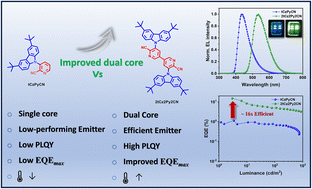
A low-performing cyanopyridine-based emitter (tCzPyCN) is converted into a highly efficient TADF emitter using homo-coupling. A dual-core counterpart (2tCz2Py2CN) is achieved by symmetrically connecting the single-core emitter, which significantly reduces the singlet–triplet energy gap (ΔEST) from 0.21 eV to 0.08 eV. The EQEmax increases from 0.94% to 15.02% due to this near-degenerate energy landscape. The enhancement results from the suppression of competing non-radiative triplet decay pathways (kTnr = 0.11 × 10⁵ s−1). This effective suppression of non-radiative loss is supported by PLQY, which nearly doubles from 33.40% to 59.10%. This study demonstrates that symmetric homo-coupling is an effective method for transforming underperforming emitters into high-performing TADF systems.
- This article is part of the themed collection: 2026 Emerging Investigator Collection
 Please wait while we load your content...


