


 PLATFORM UPDATE:


A label-free and universal CRISPR/Cas12a platform for the detection of hazardous substances in food
 *a
*a
Abstract
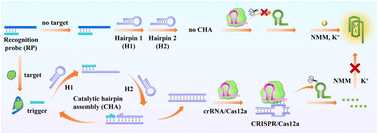
The present study proposes a label-free and universal CRISPR/Cas12a-based platform for the detection of hazardous substances in food. A label-free reporter, termed the G4 reporter, was carefully engineered. In the absence of the target analyte, the catalytic hairpin assembly (CHA) remains inactive, thereby preventing activation of the CRISPR/Cas12a system and preserving the cleavage of the G4 reporter, which emits a label-free fluorescence signal. Conversely, in the presence of the target analyte, the CHA process is triggered, activating the CRISPR/Cas12a system, which cleaves the G4 reporter into fragments, leading to a decrease in the label-free fluorescence signal. This detection strategy follows a negative response model, wherein quantification is based on the net fluorescence difference between positive and negative controls. The developed label-free signal output modality for the CRISPR/Cas12a system offers advantages of simplicity and cost-effectiveness. Moreover, the proposed method incorporates a CHA process to facilitate signal transduction and activate the subsequent CRISPR system. The system upon integration of CHA with CRISPR functions in a dual-amplification mode, resulting in enhanced signal amplification efficiency and superior sensitivity compared to the standalone CRISPR system. Thus, the platform achieves highly sensitive detection of hazardous substances, with limits of detection (LODs) of 3.0 fg mL−1 for aflatoxin B1 (AFB1) and 0.02 pg mL−1 for acetamiprid (ACE). Moreover, trace amounts of AFB1 and ACE were successfully identified in real food samples. By altering the sequences of the detection components, this platform can be readily adapted for the detection of other hazardous substances in food matrices. Therefore, this work introduces a novel, label-free, universal, and sensitive CRISPR/Cas12a-based detection platform, demonstrating considerable potential for applications in food safety surveillance and public health protection.
- This article is part of the themed collection: Analytical Methods HOT Articles 2026
 Please wait while we load your content...


