


 PLATFORM UPDATE:


A novel electrochemical aptasensor based on β-cyclodextrinylated graphene and double-stranded DNA for ultrasensitive detection of ochratoxin A
 *a
*a
Abstract
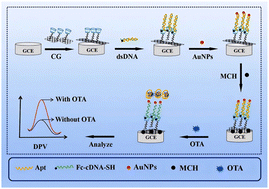
Given that ochratoxin A (OTA) exhibits immunotoxic, teratogenic, and carcinogenic properties, it is essential to monitor its presence in food samples. In the present work, a novel electrochemical aptasensor for OTA detection uses β-cyclodextrin-functionalized graphene (CG) to enhance electron transfer and provide abundant double-stranded DNA (dsDNA) binding sites. The sensor immobilizes OTA aptamers, complementary DNA (cDNA), and ferrocene-labeled dsDNA on a gold nanoparticle-modified electrode. The host–guest interaction between β-cyclodextrin (β-CD) and ferrocene (Fc) stabilizes the sensing layer, while thiolated dsDNA ensures strong attachment to AuNPs. Without OTA, impedance is high and current is low. In the presence of OTA, its high affinity for the aptamer induces conformational changes in dsDNA. Upon applying an oxidative potential, ferrocene is oxidized to Fc+, which, due to reduced hydrophobicity, dissociates from β-CD. This releases dsDNA from the electrode surface, reducing the impedance and enhancing the current response. The sensor demonstrates a robust response across a concentration range of 1 pg mL−1 to 100 ng mL−1, achieving a detection limit of 0.78 pg mL−1. Notably, this method has been successfully applied to detect OTA in wine, yielding high recovery rates of 96.20% to 98.67%. These findings suggest that the MCH/AuNPs/dsDNA/CG/GCE configuration is a promising electrochemical sensor for OTA detection.
- This article is part of the themed collection: Analytical Methods HOT Articles 2026
 Please wait while we load your content...


