


 PLATFORM UPDATE:


3D printable collagen-like protein hydrogels via dynamic covalent assembly for soft tissue engineering
 †abc
Mohandass
Pachaiyappan,
†ab
Chayla L.
Reeves,
c
Kate
Fox,
d
Amy
Gelmi
*c
and
Niraikulam
Ayyadurai
*ab
†abc
Mohandass
Pachaiyappan,
†ab
Chayla L.
Reeves,
c
Kate
Fox,
d
Amy
Gelmi
*c
and
Niraikulam
Ayyadurai
*ab
Abstract
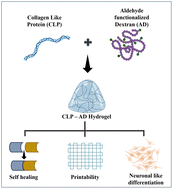
This study presents a novel 3D collagen-like protein/aldehyde-functionalized dextran (CLP–AD) hydrogel designed for tissue engineering. Developed under physiological conditions, the hydrogel forms without harsh crosslinkers or external triggers, relying on Schiff base reactions between aldehyde groups of oxidized dextran and amino groups of recombinant collagen-like protein. This dynamic covalent bonding enables a sol-to-gel transition ideal for 3D bioprinting. Comprehensive characterization confirmed its favorable gelation, swelling, degradation, and cytocompatibility profiles. Rheological analysis revealed viscoelastic and self-healing properties, making it suitable for dynamic tissue environments. Co-culture with human endothelial cells demonstrated high cell viability and migration, comparable to collagen hydrogels (RC-AD). Evaluation as a cell adhesion substrate for umbilical cord-derived mesenchymal stem cells (UC-hMSCs) revealed less spreading and fewer focal adhesions compared to the stiffer tissue culture polystyrene (TCPS) substrate, observed through immunostaining. Cell encapsulation studies with UC-hMSCs demonstrated high cell viability within the 3D matrix, supporting the hydrogel's suitability for cell-laden bioprinting applications. These findings suggest that the CLP–AD hydrogel maintains a morphology conducive to soft tissue engineering applications. This CLP overcomes the limitations associated with animal-derived collagen, such as risk of disease transmission and batch-to-batch variability. Overall, this study presents a straightforward approach for fabricating tunable and 3D-printable hydrogels, highlighting their potential for developing materials for soft tissue repair and regeneration.
- This article is part of the themed collection: Celebrating International Women’s Day 2026: Women in Journal of Materials Chemistry B
 Please wait while we load your content...


