


 PLATFORM UPDATE:


Gadolinium-doped carbon dots derived from peanut shell waste for bioimaging applications
 a
Arianna
Menichetti,
b
Marco
Montalti,
b
Konstantin
Paliienko,
cd
Michele
Iafisco
*a
a
Arianna
Menichetti,
b
Marco
Montalti,
b
Konstantin
Paliienko,
cd
Michele
Iafisco
*a
Abstract
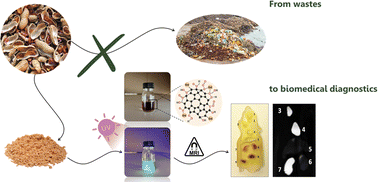
This study explores the synthesis, characterization, and biomedical potential of carbon dots (CDs) derived from food industry by-products. Gd-doped CDs were synthesized using peanut shells as a sustainable carbon source. The resulting CDs were smaller than 20 nm in size and exhibited a negative zeta potential. FTIR analysis revealed the presence of polar surface functional groups, which contributed to excellent dispersibility in water and other polar solvents. Photophysical characterization showed strong absorption in the UV region and blue fluorescence under UV irradiation. Gd3+ doping enhanced the absorption intensity in the 2–5.5 eV range and partially quenched fluorescence at high concentrations. The MRI performance of Gd-doped CDs as a positive contrast agent was assessed using 7 and 11.7 Tesla scanners. Despite their lower Gd content, Gd-doped CDs exhibited signal intensities comparable to other Gd-based contrast agents. Furthermore, cytotoxicity assays confirmed their biocompatibility with A549 cells at concentrations of up to 0.1 mg mL−1. This approach not only provides an innovative and environmentally sustainable strategy for valorising food industry waste within a circular economy framework, but also introduces a new biocompatible material for MRI imaging applications.
 Please wait while we load your content...


