


 PLATFORM UPDATE:


High-energy gamma photon engineering of g-C3N4: low dose rate radiation as a metal-free modification enhancing solar-driven photoactivity
 *a
Beata
Kalska-Szostko,
d
Inna
Soroka,
e
Mats
Jonsson
e
and
Ewa Maria
Siedlecka
a
*a
Beata
Kalska-Szostko,
d
Inna
Soroka,
e
Mats
Jonsson
e
and
Ewa Maria
Siedlecka
a
Abstract
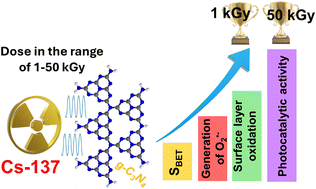
Gamma-induced modification of graphitic carbon nitride (g-C3N4) has emerged as a novel strategy for enhancing its photocatalytic performance. In this study, g-C3N4 was subjected to gamma-ray treatment at doses ranging from 1 to 50 kGy, utilising Cs-137 as the radiation source. The structural and surface properties of the irradiated g-C3N4 were extensively characterized, revealing significant alterations including exfoliation of surface layers (from 12.5 m2 g−1 to 15.0 m2 g−1), enlargement of crystalline size (from 14.9 nm to 17.0 nm), and distortion and partitioning of s-triazine units. Notably, gamma-induced modifications caused 2 times enhancement in the generation of superoxide anion radicals, which can most likely be attributed to improved separation of electron–hole pairs, as evidenced by enhanced photocatalytic degradation of various pollutants, including 5-fluorouracil (1.9 times higher), imatinib mesylate (2 times higher), and Cr(VI) (2.8 times higher). Samples irradiated with the doses of 1 kGy and 50 kGy showed the highest photoactivity, indicating the effectiveness of gamma-induced modification in enhancing the photocatalytic performance of g-C3N4. Furthermore, the stability of the irradiated samples was enhanced, with the sample irradiated at 50 kGy maintaining excellent photocatalytic activity over five continuous cycles. This study highlights the potential of gamma-induced modification as a sustainable and effective strategy for enhancing the performance of g-C3N4-based photocatalysts in environmental remediation applications.
 Please wait while we load your content...


