


 PLATFORM UPDATE:


Tailoring platinum content in a PdAuMoWPt high-entropy alloy for efficient and durable hydrogen evolution across a broad pH range

Abstract
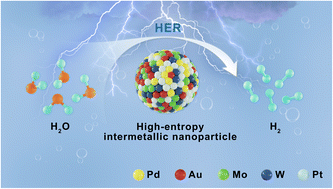
The development of highly efficient hydrogen evolution reaction (HER) electrocatalysts that combine low overpotentials with broad pH adaptability remains a formidable challenge. Here, we report a class of PdAuMoWPt high-entropy alloy (HEA) nanoparticles with tunable platinum content, synthesized via a facile oil-phase reduction strategy. These HEAs exhibit remarkable HER activity under both acidic and alkaline conditions. The composition-optimized sample, HEA-13, achieves ultralow overpotentials of 7.13 mV in 0.5 M H2SO4, 6.53 mV in 1.0 M KOH and 35 mV in 0.1 M PBS at a current density of −10 mA cm−2, along with excellent electrochemical durability over 10 000 cycles. Through a combination of experimental characterization studies and theoretical calculations, we systematically elucidate the synergistic regulation of HER activity by using the crystallographic structure and local coordination environments in the PdAuMoWPt HEAs, revealing an intrinsic structure–activity relationship. The exceptional performance is attributed to the high-entropy design, large electrochemically active surface area, robust chemical and structural stability, and the presence of diverse active sites. In particular, top (Pd, Pt), bridge (Pd–Pt, Pd–Pd), and hollow (Pd–Pd–Pd) configurations are identified as the dominant catalytic motifs governing the HER process. This work not only provides valuable insights into the rational design of efficient, cost-effective, and durable HER electrocatalysts, but also establishes a robust theoretical and structural foundation for the development of next-generation clean energy technologies.
 Please wait while we load your content...


