


 PLATFORM UPDATE:


Anode|electrolyte|cathode interface engineering to develop a robust zinc metal hydrogel battery

Abstract
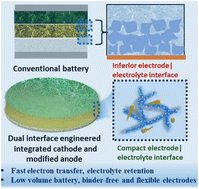
The poor electrode–electrolyte interfaces in quasi-solid-state zinc metal batteries often hinder Zn2+ ion transport due to the poor compatibility of the gel electrolyte with the electrodes. This report proposes a dual-interface engineering strategy across the anode, cathode, and separator using a single hydrogel polymer electrolyte (HPE). The integration of vanadyl phosphate functionalized carbon nanotubes (VP/fCNT) into a commercial glass fiber (GF) separator, followed by a thin hydrogel coating and UV-light photopolymerization, resulted in a dual-interface engineered cathode–separator–electrolyte structure (VP/IC-EGF). To mitigate the dendritic growth, an artificial solid electrolyte interface was developed on Zn foil (AEI@Zn). The engineered GF (EGF) demonstrates a room-temperature conductivity of 6.5 mS cm−1 and a high electrochemical stability window of 2.4 V vs. Zn|Zn2+. The symmetric cell with AEI@Zn|EGF|AEI@Zn exhibits exceptional plating/stripping stability over 1400 h at a current density of 0.1 mA cm−2 and a capacity of 0.1 mAh cm−2. Moreover, the low-volume cell (AEI@Zn‖VP/IC-EGF), featuring the dual-interface-engineered cathode–separator–electrolyte, demonstrates outstanding cycling stability with over 3000 charge–discharge cycles at a current rate of 1.0 A g−1, retaining 98–99% of its initial capacity and showing high coulombic efficiency. These findings underscore the significant impact of interface engineering on enhancing the performance of ZMBs.
 Please wait while we load your content...


