


 PLATFORM UPDATE:


Turning residual chlorides into exfoliation agents: fully gas-phase exfoliation of silicon nanosheets via amine-driven expansion for lithium-ion batteries

Abstract
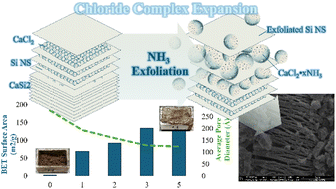
Exfoliation of silicon nanosheets (SiNSs) plays a critical role in enhancing their electrochemical performance and cycling stability in lithium-ion batteries (LIBs). In this fully gas-phase exfoliation technique, we turn a byproduct into a tool. Instead of washing away residual CaCl2 formed after reacting calcium disilicide (CaSi2), we exploit it for exfoliation by expanding pre-intercalated chlorides through the formation of amine complexes. Unlike traditional exfoliation methods, this fully gas-phase process improves uniformity, minimizes sheet breakage, and offers ease of scalability. This method uses controlled NH3 adsorption–desorption cycles to induce interlayer expansion of CaCl2, leading to a visible fivefold increase in SiNS powder volume and a fifty-fold surface area increase, as confirmed by Brunauer–Emmett–Teller analysis. X-ray diffraction further reveals enhanced 2D characteristics of the exfoliated SiNS. The process operates through a cyclic interlayer opening mechanism, enabling morphology control and the formation of interconnected multilayer nanosheets with a corrugated outer morphology. Notably, the ability of this gas-phase method to undergo multiple cycles significantly amplifies the exfoliation effect. The exfoliated SiNS exhibits superior lithium diffusivity, reduced charge transfer resistance, and exceptional cycling stability, achieving a coulombic efficiency of 99.38% over 500 cycles. The integrated, fully gas-phase reaction and exfoliation process achieves nearly 100% yield with minimal product variation, bringing silicon nanosheet production from calcium disilicide closer to large-scale application.
 Please wait while we load your content...


