


 PLATFORM UPDATE:


Highly entangled P(VDF-TrFE) solid-state electrolytes for enhanced performance of solid-state lithium batteries
 *a
and
Zhong-Ming
Li
de
*a
and
Zhong-Ming
Li
de
Abstract
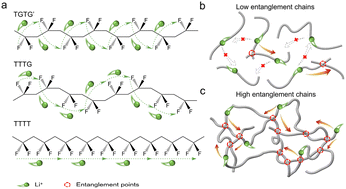
Solid polymer electrolytes (SPEs) offer a promising solution to the safety concerns of lithium metal batteries (LMBs). While poly(vinylidene fluoride) (PVDF)-based SPEs possess advantageous mechanical and thermal properties, their prevalent trans–gauche (TGTG) and TTTG conformations create tortuous ion pathways within chains, and insufficient chain entanglement leads to discontinuous transport between chains, fostering non-uniform current distribution and lithium dendrite growth. This work addresses both limitations by employing a novel poly(vinylidene fluoride-co-trifluoroethylene), P(VDF-TrFE) copolymer as the matrix of SPEs. By utilizing an ultrahigh molecular weight (2.37 × 10⁶ g mol−1) P(VDF-TrFE) synthesized via suspension polymerization, we simultaneously achieve: (1) stabilized TTTT conformation (β-phase), which forms continuous, low-resistance electronegative fluorine channels for efficient intra-chain Li+ transport, and (2) significantly enhanced chain entanglement density, which establishes a 3D interconnected ion transport network that eliminates inactive microregions, homogenizes Li+ flux, and improves mechanical resilience. Consequently, Li//Li symmetric cells based on this SPE exhibit exceptional cycling stability exceeding 5000 hours at 0.1 mA cm−2 and 25 °C, a 16-fold improvement over a lower molecular weight (0.49 × 10⁶ g mol−1) P(VDF-TrFE) SPE counterpart (∼300 hours). LiNi0.8Co0.1Mn0.1O2 (NCM811)//Li full cells also demonstrate good cycling stability. This dual optimization of molecular conformation and topological structure provides an effective strategy for enhancing ion transport continuity and uniformity in solid-state LMBs.
- This article is part of the themed collection: Most popular 2025 energy storage articles
 Please wait while we load your content...


