


 PLATFORM UPDATE:


Au-modified ZnO thin films for higher-performance ultraviolet photodetectors
 *a
and
*a
and
Abstract
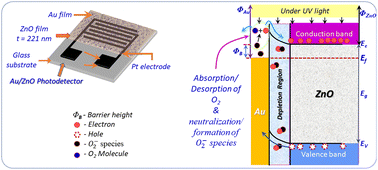
ZnO-based ultraviolet (UV) photodetectors are widely studied due to their wide bandgap and higher photosensitivity. However, the ZnO thin-film UV photodetectors face higher dark current and limited gain despite their wide bandgap advantage. Here, Au overlayers (5–40 nm) were deposited on optimized 221 nm ZnO (prepared via sol–gel method) films using cost-effective spin-coating (ZnO film) and RF sputtering (Au overlayers). Au induces Schottky barriers (ϕAu = 5.47 eV > ϕZnO = 4.45 eV) that suppress dark current down to 7.29 nA. Meanwhile, plasmonic Au nanoparticles generate localized surface plasmon resonance (LSPR) hot electrons that enhance UV absorption and photocurrent. The device with a 10 nm Au overlayer achieves an excellent photoresponse of 7.79 × 10³ and a photocurrent of 50 µA under ultra-low 24 µW cm−2 UV illumination (365 nm). This performance surpasses literature values at lower UV intensity, also among the highest reported for ZnO detectors prepared using the sol–gel method. The optimized Au–ZnO devices also exhibit fast response (Tr = 15 s) and scalable fabrication routes. These results reveal the promise of Au/ZnO hybrid thin films for sensitive, lower-intensity UV detection with applications in flame sensing, wearable optoelectronics, and environmental monitoring.
 Please wait while we load your content...


