


 PLATFORM UPDATE:

β-caryolane derivatives as novel anti-colorectal cancer agents: synthesis and in vitro biological evaluation

Abstract
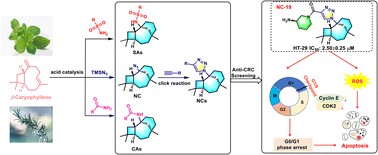
β-Caryolane derivatives possess a unique skeletal structure and a wide range of practical applications. Recent studies suggest that certain β-caryolane derivatives may exhibit enhanced anti-colorectal cancer activity compared to their natural parent compounds, β-caryolanol and β-caryophyllene (β-CP). However, the structural diversity of known β-caryolane derivatives remains limited, likely due to challenges in their synthesis. In this study, we systematically investigated, for the first time, the reactivity of three nucleophiles (sulfonamides, amides, and azide) with β-CP under acid catalysis. The corresponding β-caryolane-type products were successfully obtained in a single step. The azide-addition product further underwent click reactions with various alkynes to yield triazole derivatives. Compared to β-CP or β-caryolanol, most amino-substituted β-caryolane derivatives demonstrated significantly improved anti-proliferative activity against several colorectal cancer cell lines, especially HT-29 cells. Among them, compound NC-19 showed the most potent antiproliferative effect against HT-29 cells with an IC50 of 2.496 ± 0.255 µM. Preliminary pharmacological mechanism studies indicated that NC-19 induces apoptosis, arrests the cell cycle at the G0/G1 phase, significantly increases intracellular ROS levels and suppresses cell migration in HT-29 cells. These results expanded the chemical diversity of bioactive β-caryolane derivatives and offered new options for the development of anti-colorectal cancer agents.
 Please wait while we load your content...


