Issue 52, 2025, Issue in Progress

Synthesis of a C-TiO2/BiOCl Z-scheme composite photocatalyst for the photocatalytic degradation of tetracycline hydrochloride

Abstract

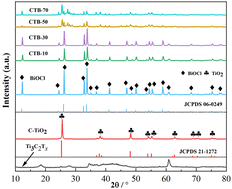
A composite photocatalyst with enhanced catalytic performance (C-TiO2/BiOCl) was prepared through a straightforward precipitation–calcination approach. The structural features, photoelectric behavior, morphology, and photocatalytic efficiency of the synthesized materials were studied via multiple analytical techniques. Compared with C-TiO2 and BiOCl, the C-TiO2/BiOCl composite displayed markedly improved photocatalytic degradation efficiency toward tetracycline hydrochloride (TCH) under simulated solar radiation. The degradation rate of TCH using the 50% C-TiO2/BiOCl (CTB-50) composite photocatalyst reached 89.9%. The increased photocatalytic efficiency of C-TiO2/BiOCl was primarily associated with its enhanced efficiency in separating photogenerated electron–hole pairs. A Z-type heterojunction photocatalytic mechanism with a C-layer as a medium was proposed based on UV-vis diffuse reflectance spectroscopy, photoelectrochemical analysis, and PL spectroscopy.
Graphical abstract: Synthesis of a C-TiO2/BiOCl Z-scheme composite photocatalyst for the photocatalytic degradation of tetracycline hydrochloride

Article information

Article type
Paper
Submitted
11 Oct 2025
Accepted
06 Nov 2025
First published
12 Nov 2025
This article is Open Access
Creative Commons BY-NC license

RSC Adv., 2025,15, 44218-44228

Synthesis of a C-TiO2/BiOCl Z-scheme composite photocatalyst for the photocatalytic degradation of tetracycline hydrochloride

F. Wu, S. Yang, J. Chen and A. Fang, RSC Adv., 2025, 15, 44218 DOI: 10.1039/D5RA07760E

This article is licensed under a Creative Commons Attribution-NonCommercial 3.0 Unported Licence. You can use material from this article in other publications, without requesting further permission from the RSC, provided that the correct acknowledgement is given and it is not used for commercial purposes.

To request permission to reproduce material from this article in a commercial publication, please go to the Copyright Clearance Center request page.

If you are an author contributing to an RSC publication, you do not need to request permission provided correct acknowledgement is given.

If you are the author of this article, you do not need to request permission to reproduce figures and diagrams provided correct acknowledgement is given. If you want to reproduce the whole article in a third-party commercial publication (excluding your thesis/dissertation for which permission is not required) please go to the Copyright Clearance Center request page.

Read more about how to correctly acknowledge RSC content.

Social activity

Spotlight

Advertisements