


 PLATFORM UPDATE:


Site-specific lithium adsorption and directional ion transport in Ti2CO2 MXenes: insights from nuclear magnetic resonance and climbing-image nudged elastic band calculations
 †bc
Duong Trong
Nhan,
de
Nguyen Truong
Long,
b
Yoshiyuki
Kawazoe
fgh
and
Minh Triet
Dang
*b
†bc
Duong Trong
Nhan,
de
Nguyen Truong
Long,
b
Yoshiyuki
Kawazoe
fgh
and
Minh Triet
Dang
*b
Abstract
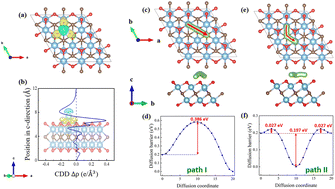
The development of advanced anode materials is critical for improving the performance of lithium-ion batteries. Ti2CO2 MXene, with its metallic conductivity and rich surface chemistry, has emerged as a promising candidate; however, the fundamental processes of lithium adsorption and diffusion remain insufficiently understood. In this work, we employ first-principles calculations combined with nuclear magnetic resonance (NMR) analysis and climbing-image nudged elastic band (NEB) simulations to investigate the lithiation mechanism of Ti2CO2. NMR shielding tensors reveal the evolution of local electronic environments, from anisotropic Ti–O–Li interactions at low lithium coverage to delocalized charge redistribution at higher lithiation, thereby stabilizing adsorption sites. NEB simulations further identify anisotropic diffusion pathways, with a dominant low-barrier channel (0.09–0.24 eV) that remains active even under high loading. These results demonstrate that Ti2CO2 provides both structural resilience and electronic conductivity, highlighting its potential as an efficient host material for next-generation lithium-ion batteries.
 Please wait while we load your content...


