


 PLATFORM UPDATE:


Engineered flower-like hierarchical Cu2S architectures mediated by carbon nanotubes and Ti3C2 for enhanced ionic diffusion and charge carriers in hybrid supercapacitors
 a
Shahid
Atiq
*a
a
Shahid
Atiq
*a
Abstract
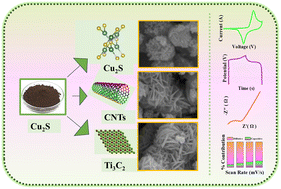
Growing global energy demands have stimulated extensive efforts toward sustainable energy solutions. In this work, Cu2S (CS) and its composites (CS-CNTs and CS-MXene) were studied for advanced supercapacitor devices. Surface analysis revealed a flower-like hierarchical architecture with high porosity, as evident by Brunauer–Emmett–Teller analysis, providing abundant active sites and promoting fast ion transport. Dunn's model analysis revealed a hybrid charge-storage behavior of all the prepared electrode materials. Among all prepared electrodes, the CS/MXene demonstrated the most superior electrochemical features in half-cell analysis, exhibiting a specific capacity (Csc) of 1692C g−1 with an impressive energy density (Ed) of 112 Wh kg−1 at a current density (Id) of 11.7 A g−1. Upon full-cell analysis, the CS/MXene composite delivered a remarkable Csc of 371.63C g−1 at Id of 3.13 A g−1, with Ed of 61.93 Wh kg−1 at Pd of 1882.35. Furthermore, the CS/MXene retained 97.5% of its initial capacity after 5000 consecutive charge/discharge cycles. Furthermore, the electrode exhibited the shortest relaxation time, moderate diffusion coefficient and the highest ionic conductivity (0.092 S cm−1), confirming its superior charge transport efficiency compared to other electrodes. Collectively, these results highlight the potential of these materials for high-performance hybrid supercapacitors.
 Please wait while we load your content...


