


 PLATFORM UPDATE:


Development of an Aspen Plus model for catalytic transesterification with different reactor arrangements and kinetic mechanisms

Abstract
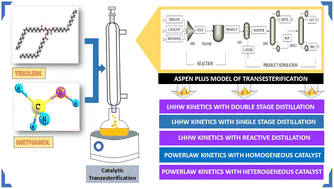
The era of dependence on fossil fuels will come to an end in a few decades, with a rising demand for alternative energy resources like biofuels. Major challenges in the preservation of the environment and ecosystem, i.e., air pollution, waste disposal, greenhouse effect, and climate change, are brought by fossil fuels only. Therefore, mankind must rebuild and upgrade its energy sector by introducing biofuels, which will not only reduce the carbon footprint but also meet the energy demands of future civilization. Biodiesel, composed of Fatty Acid Methyl Esters (FAME), is a renewable fuel and possesses almost similar fuel properties to petroleum. It is more biodegradable, less toxic, and follows an eco-friendly process of production. The most attractive option to choose for its production is the heterogeneous catalytic transesterification process. In the present study, different kinetic models are developed for the transesterification process with triolein as feed using the Langmuir–Hinshelwood–Hougen–Watson (LHHW) mechanism or power law kinetics using Aspen Plus V12.1. The process layout in Aspen Plus is built on reasonable assumptions, kinetic parameters, and optimum conditions taken from relevant literature. The optimum conversion of 96.4% is achieved in simulation with the same optimum conditions as defined in the original experimental work. Five different Aspen models have been developed with varying configurations and reaction kinetics. A comparative study of all the models reveals that Model 1, with LHHW kinetics, is more efficient than the other two models in terms of conversion efficiency, product purity, and percentage recovery.
 Please wait while we load your content...


