


 PLATFORM UPDATE:


Magnetic Fe1−xZnxFe2O4 nanoparticles as dual adsorbents for Cr(vi) and Direct Red 79: kinetics, isotherms, and mechanistic insights

Abstract
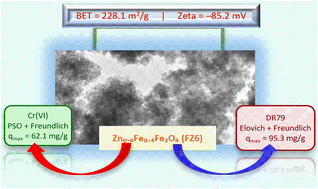
Magnetic spinel ferrites are attractive adsorbents for complex wastewaters because they couple high affinity with rapid magnetic recovery. Here, a series of Zn-substituted ferrites (Fe1−xZnxFe2O4, x = 0.0–1.0) was synthesized by co-precipitation and systematically characterized. The series samples display particles in the nanoscale range from 8–50 nm, single phase with spinel structure, tunable magnetization, and mesoporosity where the highest surface area of 228 m2 g−1 were estimated for Fe0.4Zn0.6Fe2O4 samples. The point of zero charge is obtained around 6.26, consistent with strong uptake of anionic species under mildly acidic conditions. Batch adsorption toward an organic dye (Direct Red 79, DR79) and an inorganic oxyanion (hexavalent chromium, Cr(VI)) shows optimal removal at pH = 3, with equilibrium contact times of ∼120 min for DR79 and ∼90 min for Cr(VI). Nonlinear kinetic fitting indicates Elovich behaviour for DR79 (heterogeneous chemisorption with site-energy distribution) and pseudo-second-order kinetics for Cr(VI). Intraparticle diffusion contributes to the rate of reaction but is not rate-limiting. Nonlinear isotherm analysis indicates that Freundlich is applicable to both solutes, while Langmuir capacities reach approximately 95.3 mg g−1 and 62.1 mg g−1 for DR79 and Cr(VI), respectively. Thermodynamic analysis reveals spontaneous adsorption in all cases. The uptake of DR79 is endothermic (ΔH° ≈ +79.1 kJ mol−1; ΔG° ≈ −4.5 to −8.5 kJ mol−1; ΔS° ≈ +0.271 kJ mol−1 K−1), whereas Cr(VI) is exothermic (ΔH° ≈ −40.0 kJ mol−1; ΔG° ≈ −2.0 to −0.15 kJ mol−1; ΔS° ≈ −0.126 kJ mol−1 K−1). The results highlight Fe0.4Zn0.6Fe2O4 composition displayed as a magnetically retrievable, dual-function adsorbent capable of treating mixed organic/inorganic contaminants with reliable nonlinear model parameterization for process design.
 Please wait while we load your content...


