Issue 55, 2025, Issue in Progress

The synthesis of PEG/MoS2-modified biochar for the efficient removal of Cr(vi) in solution: performance and mechanism

Abstract

A highly efficient new type of biological adsorbent (PEG/MoS2@BC) was prepared via hydrothermal synthesis using rice straw biochar, polyethylene glycol, and molybdenum disulfide as raw materials. The effects of different factors on the adsorption performance of PEG/MoS2@BC for removing Cr(VI) ions from aqueous solutions were analyzed through various experiments. The experimental results indicate that a PEG-MoS2 composite material was successfully loaded onto the surface of biochar. There was a large number of functional groups on the surface of PEG/MoS2@BC. Polyethylene glycol and biochar effectively reduced the aggregation of MoS2. The process for the adsorption of Cr(VI) by PEG/MoS2@BC can be better described using the pseudo-second-order model and the Langmuir model. The adsorption of Cr(VI) ions was an endothermic chemical process. The reaction mechanism for PEG/MoS2@BC removing Cr(VI) ions mainly includes complexation reactions, reduction reactions, electronic attraction, and physical adsorption. After five reuse cycles, the adsorption rate still reached 80.23%. The adsorption material PEG/MoS2@BC exhibited high reusability and stability.
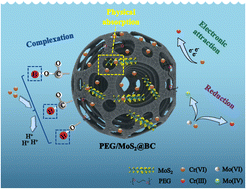
Graphical abstract: The synthesis of PEG/MoS2-modified biochar for the efficient removal of Cr(vi) in solution: performance and mechanism

Article information

Article type
Paper
Submitted
18 Sep 2025
Accepted
12 Nov 2025
First published
28 Nov 2025
This article is Open Access
Creative Commons BY-NC license

RSC Adv., 2025,15, 46967-46980

The synthesis of PEG/MoS2-modified biochar for the efficient removal of Cr(VI) in solution: performance and mechanism

W. Yang, Q. Chen and M. Qiu, RSC Adv., 2025, 15, 46967 DOI: 10.1039/D5RA07062G

This article is licensed under a Creative Commons Attribution-NonCommercial 3.0 Unported Licence. You can use material from this article in other publications, without requesting further permission from the RSC, provided that the correct acknowledgement is given and it is not used for commercial purposes.

To request permission to reproduce material from this article in a commercial publication, please go to the Copyright Clearance Center request page.

If you are an author contributing to an RSC publication, you do not need to request permission provided correct acknowledgement is given.

If you are the author of this article, you do not need to request permission to reproduce figures and diagrams provided correct acknowledgement is given. If you want to reproduce the whole article in a third-party commercial publication (excluding your thesis/dissertation for which permission is not required) please go to the Copyright Clearance Center request page.

Read more about how to correctly acknowledge RSC content.

Social activity

Spotlight

Advertisements