


 PLATFORM UPDATE:


Density functional theory insights into the formation mechanisms and reaction rates of Strecker aldehydes

Abstract
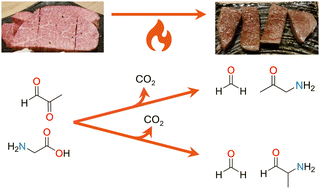
Although Strecker degradation significantly affects food quality, its atomistic-level reaction mechanisms remain poorly understood. In this study, new reaction mechanisms for the initial steps of Strecker degradation leading to the formation of aldehydes or ketones were revealed using a first-principles approach based on density functional theory (DFT). We employed a minimal model consisting of glycine and methylglyoxal, and explored a broad reaction space using the conformational search algorithm, the random sampling method. Our results show that both aldehyde and ketone formation pathways proceed with maximum activation energies of less than 25 kcal mol−1. According to rate calculations using the Eyring equation, such activation energies correspond to slow reaction rates at around 298.15 K, but significantly accelerated rates at elevated temperatures above 373 K. We also demonstrated that solvation effects influence the preference between two distinct reaction pathways (Path A and Path B). These newly proposed reaction mechanisms for the initial stage of Strecker degradation provide valuable insights into the promotion or regulations of specific reactions, intermediates and end products during food processing.
 Please wait while we load your content...


