Issue 46, 2025, Issue in Progress

Synergistic hydrolysis, coordination and hydrogen bond interactions in NIPS for underwater superoleophobic mesh-based oil/water separation

Abstract

Constructing a durable, high-flux, and fouling-resistant coating on metal meshes without compromising their structural integrity remains a formidable challenge. Herein, we report a novel non-solvent induced phase separation (NIPS) strategy that enables the synchronous occurrence of antimony trichloride hydrolysis, metal–polyphenol coordination, and PVP–TA hydrogen bonding during membrane formation, realizing collaborative interface engineering of membrane formation and functionalization in a single step. The synergistic effect leads to the in situ growth of a robust superhydrophilic network on the metal mesh without destroying the substrate. The resulting membrane achieves a high flux (8000 L m−2 h−1) under gravity, along with excellent underwater self-cleaning ability and chemical stability. This work provides an efficient, time-saving, and economical method to prepare high flux and underwater self-cleaning wire mesh oil–water separation membranes.
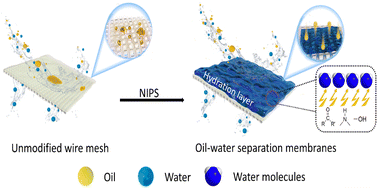
Graphical abstract: Synergistic hydrolysis, coordination and hydrogen bond interactions in NIPS for underwater superoleophobic mesh-based oil/water separation

Supplementary files

Article information

Article type
Paper
Submitted
24 Aug 2025
Accepted
09 Oct 2025
First published
15 Oct 2025
This article is Open Access
Creative Commons BY-NC license

RSC Adv., 2025,15, 38603-38611

Synergistic hydrolysis, coordination and hydrogen bond interactions in NIPS for underwater superoleophobic mesh-based oil/water separation

Y. Liu, Y. Li, C. He, X. Yue, S. Hu, H. Wang, N. A. Khan, C. Yang and M. Long, RSC Adv., 2025, 15, 38603 DOI: 10.1039/D5RA06305A

This article is licensed under a Creative Commons Attribution-NonCommercial 3.0 Unported Licence. You can use material from this article in other publications, without requesting further permission from the RSC, provided that the correct acknowledgement is given and it is not used for commercial purposes.

To request permission to reproduce material from this article in a commercial publication, please go to the Copyright Clearance Center request page.

If you are an author contributing to an RSC publication, you do not need to request permission provided correct acknowledgement is given.

If you are the author of this article, you do not need to request permission to reproduce figures and diagrams provided correct acknowledgement is given. If you want to reproduce the whole article in a third-party commercial publication (excluding your thesis/dissertation for which permission is not required) please go to the Copyright Clearance Center request page.

Read more about how to correctly acknowledge RSC content.

Social activity

Spotlight

Advertisements