


 PLATFORM UPDATE:


Portable smartphone-integrated ratiometric fluorescence probe for visual detection of mercury ions in environmental water with greenness evaluation

Abstract
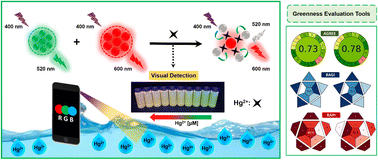
Mercury is an extremely hazardous environmental pollutant with strong bioaccumulation potential, underscoring the need for rapid and sensitive detection of mercury ions (Hg2+) to protect both the environment and public health. In this work, a ratiometric fluorescence sensor was developed for the selective detection of Hg2+. The use of ratiometric fluorescence probes minimizes background interference, thereby enhancing accuracy compared to single-emission intensity-based nanoprobes. The sensor was fabricated by combining red carbon dots (r-CDs) with green carbon dots (g-CDs). The developed ratiometric probe exhibited high sensitivity, achieving a remarkably limit of detection (LOD) of 60 nM. Furthermore, the sensor's capability for visual detection was validated through a smartphone-based solution assay, with a LOD of 26.68 μM. To assess its environmental sustainability, three greenness assessment metrics AGREE, BAGI, and RAPI were employed, all confirming the method's outstanding eco-friendliness. Overall, the synthesized probe demonstrates strong potential for practical applications in the detection of Hg2+ in real samples.
 Please wait while we load your content...


