


 PLATFORM UPDATE:


Rational methodology of V–Al alloy-electrorefining protocols promotes high purity vanadium metal
 abcd
abcd
Abstract
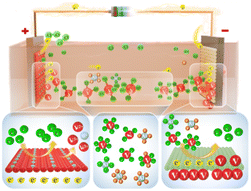
Molten salt electrolysis is a promising method for producing metallic vanadium, overcoming the limitations of conventional processes, such as high purity requirements for raw materials and high impurity content. This study introduces an innovative approach utilizing soluble vanadium–aluminum alloy anodes in KCl–LiCl molten salt, where vanadium is dissolved as V2+ and V3+. Optimal conditions were identified as 0.3 A cm−2 current density, 500 °C temperature, and 6 h duration. High purity metallic vanadium was prepared under these conditions, and the electrolysis efficiency reached 89.53%. Electrochemical analysis revealed three reduction processes: Al(III) → Al, V(III) → V(II) and V(II) → V. In molten salts, vanadium ions existed in coordination forms as VCl2, VCl3, VCl42−, and VCl63−, while aluminum ions were present as AlCl4−. The process was confirmed as diffusion-controlled, with calculated V(III) diffusion coefficients. Nucleation mechanism analysis demonstrated dual vanadium deposition pathways: instantaneous and progressive nucleation. Fluoride ions were found to enhance reaction kinetics through chloride substitution in aluminum complexes, increasing free chloride availability for vanadium coordination and improving ion mobility. The developed method offers significant advantages in energy efficiency and product quality compared to traditional metallurgical approaches, providing insights for optimization of molten salt electrolysis systems in refractory metal production.
 Please wait while we load your content...


