


 PLATFORM UPDATE:


Development of a green spectrofluorimetric method for mefenamic acid determination using Rhodamine 6G with mechanistic investigation and central composite design optimization
 *e
and
*e
and
Abstract
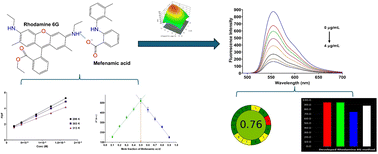
Spectrofluorimetry has emerged as a powerful analytical technique offering high sensitivity, selectivity, and environmental compatibility for pharmaceutical analysis. This study aims to develop a novel fluorescence quenching method for mefenamic acid determination using Rhodamine 6G as a molecular probe. Comprehensive spectral characterization revealed that Rhodamine 6G exhibits characteristic absorption at 530 nm and emission at 555 nm, with systematic fluorescence quenching upon mefenamic acid addition while preserving the emission spectral profile. Mechanistic investigation through Stern–Volmer analysis, thermodynamic studies, and Job's method established static quenching via 1 : 1 ground-state complex formation with thermodynamic analysis revealing favorable binding driven by electrostatic and π–π interactions. Moreover, central composite design optimization was employed to systematically evaluate pH, Rhodamine 6G concentration, and reaction time, establishing optimal conditions that achieved 76.4% quenching efficiency. Additionally, ICH validation demonstrated excellent analytical performance including linearity over 0.1–4.0 μg mL−1 (r2 = 0.9996), detection limit of 29.2 ng mL−1, accuracy of 98.48%, and precision <2% RSD. Method applications encompassed pharmaceutical formulations with statistical equivalence to reference HPLC methods and human plasma samples with recoveries of 96.30–102.21%. Furthermore, sustainability assessment revealed the superior environmental performance (AGREE score: 0.76 vs. 0.66, whiteness: 88.1% vs. 72.7%) compared to conventional HPLC methods. This work establishes a practical green alternative for routine mefenamic acid analysis in pharmaceutical quality control and therapeutic monitoring.
 Please wait while we load your content...


