Issue 36, 2025

Hybrid nucleobase–heterocycle–2-oxindole scaffolds as innovative cell cycle modulators with potential anticancer activity

Abstract

A series of hybrid molecules 6a–6d13a–13d combining pyrazolo[3,4-d]pyrimidine or aminopurine frameworks with an oxindole moiety were designed as multitarget anticancer agents. Several compounds, especially 8b and 12a–12d, showed potent antiproliferative effects against three human cancer cell lines: A498 (kidney carcinoma), HepG-2 (hepatocellular carcinoma), and MDA-MB-231 (breast adenocarcinoma). Compounds 6b, 7b, 8b, and 12a–12c exhibited remarkable CDK6 inhibition (pIC50 of up to 7.17), outperforming palbociclib, and VEGFR-2 inhibition comparable to sorafenib. These compounds also inhibited xanthine oxidase. Notably, 12a and 12c induced sub-G1 cell cycle arrest in HepG2 cells. Molecular modeling confirmed stable binding to CDK6 and VEGFR-2, while in silico ADMET profiling suggested favorable pharmacokinetics. These results support 8b and 12a–12c as strong leads for further multitarget cancer therapy development.
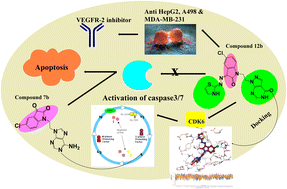
Graphical abstract: Hybrid nucleobase–heterocycle–2-oxindole scaffolds as innovative cell cycle modulators with potential anticancer activity

Supplementary files

Transparent peer review

To support increased transparency, we offer authors the option to publish the peer review history alongside their article.

View this article’s peer review history

Article information

Article type
Paper
Submitted
12 Jul 2025
Accepted
06 Aug 2025
First published
22 Aug 2025
This article is Open Access
Creative Commons BY-NC license

RSC Adv., 2025,15, 29753-29776

Hybrid nucleobase–heterocycle–2-oxindole scaffolds as innovative cell cycle modulators with potential anticancer activity

G. A. Abdel-Hafez, D. Kłopotowska, B. Filip-Psurska, A. S. Aboraia, J. Wietrzyk, T. Aboul-Fadl and A. F. Youssef, RSC Adv., 2025, 15, 29753 DOI: 10.1039/D5RA04997K

This article is licensed under a Creative Commons Attribution-NonCommercial 3.0 Unported Licence. You can use material from this article in other publications, without requesting further permission from the RSC, provided that the correct acknowledgement is given and it is not used for commercial purposes.

To request permission to reproduce material from this article in a commercial publication, please go to the Copyright Clearance Center request page.

If you are an author contributing to an RSC publication, you do not need to request permission provided correct acknowledgement is given.

If you are the author of this article, you do not need to request permission to reproduce figures and diagrams provided correct acknowledgement is given. If you want to reproduce the whole article in a third-party commercial publication (excluding your thesis/dissertation for which permission is not required) please go to the Copyright Clearance Center request page.

Read more about how to correctly acknowledge RSC content.

Social activity

Spotlight

Advertisements