


 PLATFORM UPDATE:


Development of Cu-MOF@PVDF–PS hybrid membranes for high-temperature proton exchange membranes: electrospinning, characterization, and fuel cell performance

Abstract
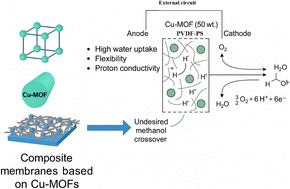
Nafion membranes, while widely used in fuel cells, suffer from high cost, limited methanol resistance, and thermal instability. This study addresses these limitations by developing a Cu-MOF@PVDF–PS nanofiber membrane with enhanced proton conductivity and structural durability. The proton exchange membrane was fabricated using electrospun nanofibers derived from a polymer blend of polyvinylidene fluoride (PVDF) and polystyrene (PS). The electrospinning technique facilitated the formation of numerous tiny ionic aggregates on the membrane surface, enhancing proton conductivity. To further improve conductivity, metal–organic frameworks (MOFs) were incorporated into the polymeric membranes, enabling tunable proton conduction. In this work, a Cu(II)-based metal–organic framework (Cu-MOF) was incorporated into the PVDF–PS blend to produce hybrid membranes (Cu-MOF@PVDF–PS) with varying MOF content. The impact of different Cu-MOF loadings on the conductivity of the membrane composites was thoroughly examined. Notably, the Cu-MOF 50 wt%@PVDF–PS membrane demonstrated proton conductivity of up to 61.4 mS cm−1 at 353 K. The improved proton conductivity of this hybrid membrane is attributed to contributing the formation of extended range conductive network through electrospinning, followed by hot pressing, and the synergistic effects among Cu-MOF and PVDF–PS. This research paves the way for further advancements in MOF/nanofiber composite membranes for proton-conducting applications.
 Please wait while we load your content...


