


 PLATFORM UPDATE:


Selective adsorption of Pb(ii) on green Sn-BDC-MOF/GO composite: optimization, DFT studies and mechanism

Abstract
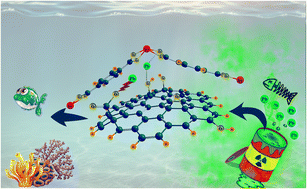
Scientists have made significant strides in removing heavy metals like lead (Pb(II)) from water, recognizing their adverse effects on human health. A new, eco-friendly composite material, Tin-benzene dicarboxylic acid metal organic framework/graphene oxide (Sn-BDC-MOF/GO), has been developed for this purpose. This material was meticulously analyzed using various chemical, textural, and structural techniques to confirm its effective creation. Through experiments, it was found that Sn-BDC-MOF/GO efficiently removes Pb(II) ions at 25 °C and a pH of 6, following a second-order kinetic model. The adsorption capacity reached a maximum of 200.0 mg g−1, suggesting both chemical and physical adsorption processes as evidenced by Langmuir and Freundlich isotherm models. Thermodynamic analysis showed that adsorption is orderly, exothermic, and spontaneous. Furthermore, we examined the effect of interfering ions on the composite’s affinity, demonstrating excellent selectivity toward Pb(II) ions and good recyclability over six cycles. Advanced spectroscopic methods, Density Functional Theory (DFT), and Monte Carlo simulations provided deep insights into the adsorption mechanism, particularly the electronic structure and intermolecular interactions. DFT calculations pinpointed the most effective adsorption sites and estimated significant adsorption energies, enhancing our understanding of the molecular-level adsorption process. This study not only advances our knowledge in creating efficient adsorbents for heavy metal removal from water but also emphasizes the crucial role of DFT in understanding and optimizing adsorption mechanisms.
 Please wait while we load your content...


