Issue 41, 2025, Issue in Progress

Portable ratiometric fluorescence sensor based on CuNCs@EuMOFs for visual detection of Hg(ii) in water samples

Abstract

Mercury ions (Hg2+) are highly toxic and bioaccumulative, posing a serious threat to the environment and human health. Traditional analytical techniques are limited by cost, portability and real-time monitoring capabilities, and there is an urgent need for sensitive and portable detection methods. In this study, copper nanoclusters (CuNCs) were encapsulated in red-emitting europium metal–organic frameworks (Eu-MOFs), and a ratiometric fluorescence probe based on CuNCs@EuMOFs was constructed and used for the detection of Hg2+ in water extracts of traditional Chinese medicine samples and river samples. In the presence of Hg2+, the fluorescence of this probe is enhanced at 450 nm and weakened at 618 nm. Visual quantification can be performed using a smart phone based on the color change. The linear range is 0–360 μM (R2 = 0.9986), and the detection limit is 0.94 nM. The sample recovery rate was 94.43–106.43% (RSD < 4.37%). This study provides a new strategy for the portable visual detection of Hg2+ in complex matrices.
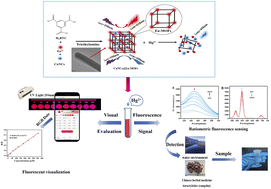
Graphical abstract: Portable ratiometric fluorescence sensor based on CuNCs@EuMOFs for visual detection of Hg(ii) in water samples

Supplementary files

Article information

Article type
Paper
Submitted
09 Jun 2025
Accepted
11 Sep 2025
First published
17 Sep 2025
This article is Open Access
Creative Commons BY-NC license

RSC Adv., 2025,15, 33991-34002

Portable ratiometric fluorescence sensor based on CuNCs@EuMOFs for visual detection of Hg(II) in water samples

J. Tian, C. Wang, Y. Wang, X. Zhang, J. Pang, C. Li and S. Tang, RSC Adv., 2025, 15, 33991 DOI: 10.1039/D5RA04013B

This article is licensed under a Creative Commons Attribution-NonCommercial 3.0 Unported Licence. You can use material from this article in other publications, without requesting further permission from the RSC, provided that the correct acknowledgement is given and it is not used for commercial purposes.

To request permission to reproduce material from this article in a commercial publication, please go to the Copyright Clearance Center request page.

If you are an author contributing to an RSC publication, you do not need to request permission provided correct acknowledgement is given.

If you are the author of this article, you do not need to request permission to reproduce figures and diagrams provided correct acknowledgement is given. If you want to reproduce the whole article in a third-party commercial publication (excluding your thesis/dissertation for which permission is not required) please go to the Copyright Clearance Center request page.

Read more about how to correctly acknowledge RSC content.

Social activity

Spotlight

Advertisements