


 PLATFORM UPDATE:


Construction of a 1D/0D/2D BiFeO3/Ag/g-C3N4 Z-scheme heterojunction for enhanced visible light photocatalysis of methylene blue
 *a
*a
Abstract
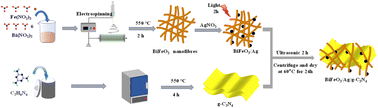
To improve the utilization of solar energy and the efficiency of photocatalytic organic pollutant degradation, novel Z-scheme heterojunctions with high visible light catalytic performances have been widely developed. Herein, a novel Z-scheme BiFeO3/Ag/g-C3N4 heterojunction with a hierarchical 1D/0D/2D structure and visible light absorption was constructed by matching the suitable band structure between 1D BiFeO3 and 2D g-C3N4 and employing the localized surface plasmon resonance (LSPR) effect of 0D Ag nanoparticles. BiFeO3 nanofibers were synthesized via the electrospinning technique, providing short electron transport paths and visible light absorption range for g-C3N4. Plasmonic Ag nanoparticles were photodeposited on the surface of BiFeO3 to enhance the separation efficiency of the photogenerated electron–hole pairs between the bulk interfaces. UV-vis DRS, PL, photocurrent and EIS spectra confirmed the important roles of Ag and BiFeO3 in improving the photocatalytic activity of the Z-scheme heterojunction. The working principle of the BiFeO3/Ag/g-C3N4 Z-scheme heterojunction was proposed, indicating that ˙O2− and ˙OH are the main active species for the photocatalytic degradation of methylene blue (MB). The prepared BiFeO3/Ag/g-C3N4 heterojunction exhibited the highest photocatalytic activity, where its rate constant was 5.84 times higher than that of the pristine BiFeO3 and 3.26 times higher than that of the pristine g-C3N4. This study offers a new means for the design of novel high-performance photocatalysts, which can be a promising candidate in industrial applications.
 Please wait while we load your content...


